
Figures as of Tue 24 Nov 2026 close, $40.19
Education only — not financial advice. Not a recommendation to buy, sell, or hold HPE, Dell, or Ambarella. HPE, Dell and Ambarella are US-listed stocks, priced in USD. Paper trading only: our $10,000 paper account, $100 risk per trade. No real money is involved, and no trade was placed.
What happened
Hewlett Packard Enterprise (HPE) reported its fiscal fourth quarter on Monday, November 23, 2026, and on paper it was strong: revenue of $14.5 billion, up 50% from a year earlier, and adjusted earnings of $1.43 per share, beating the roughly $1.27–$1.29 analysts expected. The company raised its fiscal 2027 outlook to revenue of $59.4–$63.1 billion and adjusted earnings of $5.05–$5.35 per share. (Motley Fool, November 24, 2026; Zacks, November 24, 2026; Morningstar, November 24, 2026.)
The stock rose about 17% on Monday. On Tuesday, November 24, it gave the whole move back — and more — closing at $40.19, down $7.83, or 16.31%, on about 46.6 million shares. It opened at $42.36, touched $39.42, and slipped a further 0.5% after hours. (Finnhub, November 24, 2026; stockanalysis.com, November 24, 2026.)
Why a beat-and-raise stock fell 16%
The market did not sell the quarter. It sold the margins.
HPE’s Cloud & AI division — the unit selling the AI servers — earned an 18.4% operating margin in the quarter just reported, but management guided it to about 14% for fiscal 2027, and companywide operating margin to 14%–15%, down from 15.1% in fiscal 2026. In plain terms: HPE is selling far more AI hardware and making less money on each box. Cloud & AI revenue rose 68.6% in the quarter to $11.3 billion — but the profit on that growth is thinner than the market assumed. (Motley Fool, November 24, 2026; XTB, November 24, 2026.)
Supply is the second problem: memory, NAND, and other critical components are expected to remain constrained until at least the second half of 2028. (Motley Fool, November 24, 2026; XTB, November 24, 2026.)
What it does and doesn’t change
What changes is the profitability thesis for AI hardware. Until now, the AI server story has mostly been told in revenue — record quarters, record backlogs, triple-digit growth. HPE’s report says the revenue is real and the margin on it is shrinking: a genuine thesis change for HPE, and a warning for the sector that growth alone no longer lifts these stocks if the margin goes the wrong way. What doesn’t change is AI demand — HPE raised its revenue outlook, it did not cut it — and nothing here changes our watchlist names directly. This is HPE’s margin problem, not Nvidia’s.
The Dell contrast: same boom, opposite margins
The same evening, Dell reported — and the contrast is the most useful part of this story. Dell’s revenue more than doubled to a record $54.9 billion (+103%), with adjusted earnings of $9.45 per share against about $6.60 expected. Its Infrastructure Solutions Group earned a 17% operating margin, up from 12.4% a year ago, and Dell raised full-year revenue guidance to $202 billion from $192 billion. (Dell Technologies press release / 8-K Exhibit 99.1, November 24, 2026; Morningstar / Dow Jones, November 24, 2026.)
So in one evening: Dell’s AI server margin expanded to 17%; HPE’s is guided down to about 14%. Same AI boom, opposite margin directions. The question to carry forward is which AI hardware sellers can hold their margins as volumes explode — and which cannot. Dell itself guided its ISG margin to just under 15% for Q4, so the pressure reaches Dell too — just a quarter later. Note the timing: Dell fell 11.83% in Tuesday’s session, to $295.28, before its results were released — the sector-wide sell-off, not a reaction to its numbers. After the print it rose about 2–3% after hours, to roughly $305. (Motley Fool, November 24, 2026.)
A third data point arrived after Tuesday’s close: Ambarella, a smaller edge-AI chipmaker, guided fourth-quarter revenue about 35% below consensus and fell more than 40% after hours, blaming memory shortages. (Seeking Alpha, November 24, 2026.) It is a small, loss-making name outside our large-cap filter — but its warning matches HPE’s: memory supply is now the binding constraint on AI hardware.
Chart snapshot
The technical read: Tuesday’s high was $42.49 and its low $39.42, on about 46.6 million shares — roughly two and a half times usual volume. Over five sessions the stock is down 16.77%; over one month, down 29.11%. Its 52-week range is $19.84 to $73.56. (Finnhub, November 24, 2026; stockanalysis.com, November 24, 2026.)
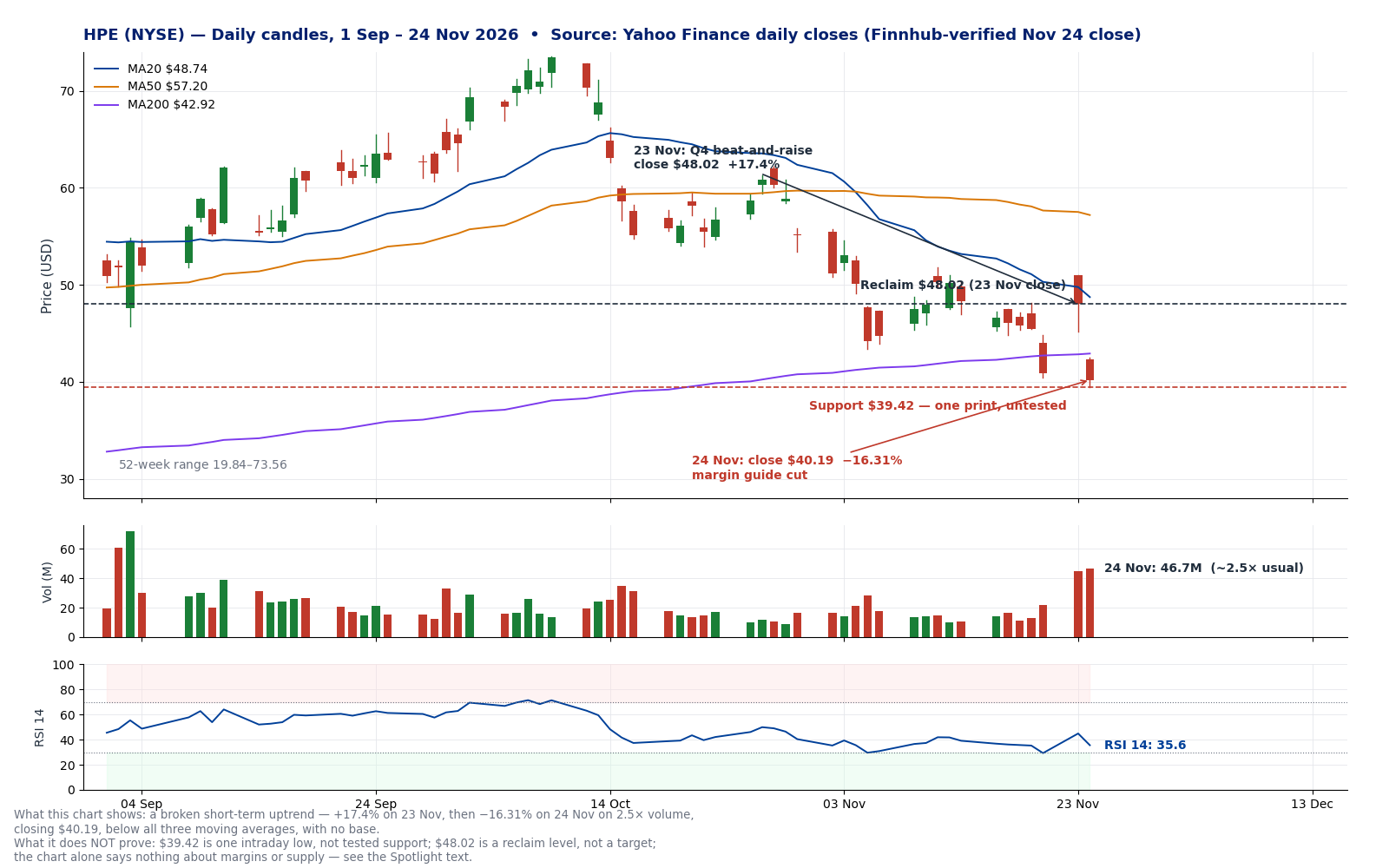
Chart caption: HPE (NYSE), daily candles, 1 September – 24 November 2026. Source: Yahoo Finance daily closes (Finnhub-verified 24 Nov close). Indicators: MA20 $48.74, MA50 $57.20, MA200 $42.92, RSI 14: 35.6, volume 46.7M on 24 Nov (~2.5× usual). Support/resistance marked: $39.42 (24 Nov low), $48.02 (23 Nov close, reclaim level), 52-week range $19.84–$73.56. What it shows: a broken short-term uptrend — +17.4% on 23 Nov, then −16.31% on 24 Nov on 2.5× volume, closing $40.19 below all three moving averages, with no base. What it does not prove: $39.42 is one intraday low, not tested support; $48.02 is a reclaim level, not a target; the chart alone says nothing about margins or supply.
A broken short-term uptrend, not a base.
Trader implication: watchlist only, no trade
No trade. There is no clean swing setup here: a stock down 16% in a day on a guidance cut, with no base and no tested support, is a falling knife, not an entry. We do not chase gap-downs or buy a margin problem on hope. Paper account unchanged: $10,000 cash, 0 positions, 0 trades.
What would have to change before we revisit HPE: (1) margins stabilise — a reported quarter in which Cloud & AI margin holds or re-expands, not compresses toward 14%; (2) a base forms — the stock holds above $39.42 and reclaims $48.02 on strong volume; (3) supply visibility improves — any easing of the memory constraints expected to last until the second half of 2028.
Until then, HPE is a lesson, not a position: the market trades guidance and margins, not the quarter just reported.
Risks
The margin guide could prove conservative — if pricing improves or costs ease sooner than expected, the stock could recover faster than this read assumes. The AI hardware group is also moving together: Tuesday’s sell-off hit Nvidia, AMD, Intel, Dell, and HPE alike, and a sector rebound would lift HPE with it. This is about one company’s report, not a verdict on AI spending or on any other watchlist name.
Key takeaway
- HPE beat its quarter and raised its full-year outlook — and fell 16% in a day, because the market was pricing the margin, not the revenue.
- Cloud & AI margin is guided to about 14% for fiscal 2027, down from 18.4% in the quarter just reported.
- Component shortages are expected to last until at least the second half of 2028.
- Dell, the same evening, showed the opposite margin direction: its AI server margin expanded to 17%.
- No trade. Watchlist only, with three explicit revisit triggers above.
Education only. This article explains what happened and why; it is not a recommendation to buy or sell any security, and it is not tailored advice. HPE is a US-listed stock (NYSE: HPE). Dell is US-listed (NYSE: DELL). Ambarella is US-listed (NASDAQ: AMBA). All prices in US dollars unless stated. Paper-trading disclosure: Investingnetwork’s paper account holds $10,000 USD in cash, 0 open positions, and 0 trades taken. No position in HPE, Dell, or Ambarella is held or planned.
Sources
- Motley Fool, “Why Hewlett Packard Enterprise Stock Fell 16% Today“, November 24, 2026
- Motley Fool, “HP Enterprise (HPE) Q4 2026 Earnings Call Transcript”, November 24, 2026 (call date: Monday, November 23, 2026)
- Morningstar / MarketWatch, “HPE just posted its strongest growth ever — but its stock is sinking”, November 24, 2026
- Zacks, “HPE Q4 Earnings Call Highlights Raised Outlook for AI Shipments“, November 24, 2026
- XTB, “AI stocks slide again — Hewlett Packard tumbles nearly 12% after earnings“, November 24, 2026
- Dell Technologies, press release / 8-K Exhibit 99.1, “Dell Technologies Delivers Third Quarter Fiscal 2027 Financial Results“, November 24, 2026
- Morningstar / Dow Jones, “Dell Lifts Outlook as 3Q Revenue Doubles on Server Demand; Adds $25 Billion to Buyback Plan”, November 24, 2026
- Motley Fool, “Dell Just Reported Earnings and Raised Its Forecast by $10 Billion“, November 24, 2026
- Seeking Alpha, “Ambarella collapses 40% as Q4 guidance falls shockingly short of estimates“, November 24, 2026
- Ambarella, Inc., press release via GlobeNewswire, “Ambarella, Inc. Announces Third Quarter Fiscal Year 2027 Financial Results”, November 24, 2026
- Finnhub, HPE quote snapshot, November 24, 2026 (close $40.19, previous close $48.02, low $39.42, volume data)
- stockanalysis.com, HPE stock price history, November 24, 2026
- Motley Fool, “Stock Market Today, Nov. 24: Nvidia Gives Back $240 Billion in Market Value”, November 24, 2026 (NVDA close $155.38, −5.86%)