
Date: 23 November 2026 | Ticker: NVDA (NVIDIA Corporation, Nasdaq) | Currency: USD | Last regular-session close used: Monday 23 November 2026 — $165.05
Education only — not financial advice. Not a recommendation to buy, sell, or hold NVDA. This article is for learning how to analyse a stock, not tailored advice. All paper-trade maths use our flagship paper rules only: a $10,000 USD paper account, 1% risk per trade ($100), a maximum of four positions, a maximum of 25% per position ($2,500), a stop is mandatory, and a target of 1.5–2R. No real money is involved. No trade was placed.
Canada / US label: NVDA is a US-listed stock, traded in US dollars on the Nasdaq. Figures below are in USD unless stated otherwise. Prices and news are as of 23 November 2026, and will be out of date the next trading day.
Update — 23 November 2026 (after close): this article was first written as of the Friday 20 November close ($125.53). On Monday 23 November, Nvidia’s board voted unanimously the previous day to reinstate Jensen Huang as President, CEO and board director, effective immediately — reversing the board’s 17 November position — and the stock closed at $165.05, up 31.48% in one day. Everything below has been updated to the Monday 23 November close, with the technicals recomputed and the verdict re-derived. The verdict is unchanged: watchlist only, no clean swing setup, no trade. The full reinstatement story is in our News Spotlight, “NVDA: Huang Is Back — and the Stock Jumped 31% in a Day“.
Update — 24 November 2026 (close, added by Editor): NVDA closed at $155.38, down 5.86% on the day, on volume of about 384 million shares — above $150.96, so the second-session test in point 1 of “What Would Have to Change” has now passed on price and volume. The verdict is unchanged: still no base, ATR has not contracted, and the SEC probe is unresolved, so there is still no clean swing setup. All figures below remain as of the 23 November close unless stated otherwise.
Key Takeaway
- Record quarter, falling stock. Q3 FY27 revenue was $115.8 billion on 17 November 2026, up 103% year-on-year. Data Center revenue was $107.6 billion, up 110%. GAAP earnings per share were $2.70, up 108%. Net income was $65.3 billion. Q4 guidance was revenue of $130.0 billion ±3%.
- The price fell anyway — sharply — then jumped in one day. NVDA closed at $125.53 on Friday 20 November 2026, down 14.01% that day, down 48.4% from its 6 October 2026 intraday high of $243.37. On Monday 23 November it closed at $165.05, up $39.52, up 31.48% in one day, on about 778 million shares. Even after that jump it is still 32.2% below the 6 October high.
- The fall was driven by governance and regulatory news, not by the quarter — and the governance news has now reversed. Founder and CEO Jensen Huang resigned on 11 November 2026. CFO Colette Kress was appointed interim CEO. On 17 November, Chair Harvey Jones said the board did not intend to reinstate Huang. On Sunday 22 November the board voted unanimously to reinstate him as President, CEO and board director, effective immediately, and announced it on Monday 23 November. Reuters reported on 20 November that SEC enforcement staff are probing potential accounting issues. The SEC declined to comment. No finding of wrongdoing has been published, and the reinstatement does not close the independent investigation, which continues.
- Technically, the trend is still down, but one day changed the numbers. Price is still below its 20-, 50- and 200-day moving averages ($178.91 / $206.08 / $203.24 on 23 November). The 14-day RSI is 42.9, back above 30 from 15.0 on 20 November. The 14-day average true range is $15.62 — up from $12.84, so volatility expanded, it did not contract. There is no base, no higher low, and no second confirming session above $150.96 yet (as of 23 Nov — see the 24 Nov update note above). $156.93 — the 23 November intraday low — is one print only, not tested support.
- Verdict: watchlist only. No clean swing setup, and no trade. Under our $10,000 paper account and $100 risk rule, no stop distance is both wide enough to survive a normal day and tight enough to give a meaningful position and a clean 1.5–2R target.
The Business
NVIDIA designs graphics processing units (GPUs) and the software that runs on them — principally CUDA, its parallel-computing platform — plus networking and full data-centre systems, including Blackwell, Blackwell Ultra, and the Vera Rubin NVL72 system, which the company said has shipped. In plain English, it sells the “shovels” for artificial intelligence: hyperscalers and AI labs buy its chips to train and run large AI models, and enterprises buy them through cloud providers and system builders such as Dell, Supermicro, and Lenovo. Data Center contributed $107.6 billion in Q3 FY27 — 93% of total revenue — up 110% year-on-year. Edge Computing contributed $8.2 billion, up 42%.
NVIDIA’s advantage rests on the CUDA ecosystem, built over more than 15 years, so switching a large AI workload to another chip is not a like-for-like swap, plus performance leadership, with a full stack (chip, networking, and software). That advantage is being tested: hyperscalers are building their own custom silicon (Google TPU, Amazon Trainium, Microsoft Maia, Meta MTIA), AMD is the credible second source, and export controls limit sales to China — Q4 guidance assumes no Data Center compute sales there. Demand is broadening: Data Center split in Q3 into Hyperscale ($60.1 billion, +71% year-on-year) and AI Clouds, Industrial & Enterprise ($47.5 billion, +195%). The moat is wide today, narrowing at the edges.
Concentration is material: two direct customers accounted for 18% and 17% of accounts receivable as of 25 October 2026. Receivables rose to $81.0 billion at 25 October 2026, from $38.5 billion at 25 January 2026, and days sales outstanding (DSO) was reported at 64 days — the highest since 2022 in secondary summaries of the filing. That does not prove a problem by itself; revenue doubled over the same period. But it is the kind of working-capital trend the SEC probe reporting is now circling, and a learner should watch it in the next 10-Q. Neoclouds and frontier labs (CoreWeave and similar) are a growing, capital-constrained customer group, and NVIDIA has provided financing and guarantees to some of them — a “circular financing” debate the Q3 numbers do not settle.
Fundamentals
Q3 FY27, the quarter ended 25 October 2026 and reported 17 November 2026, was one of the strongest quarters any company has reported. Revenue was $115.8 billion, up 103% year-on-year; Data Center $107.6 billion, up 110%; Edge Computing $8.2 billion, up 42%; GAAP gross margin 74.8% (up 1.4 points year-on-year); GAAP operating income $77.5 billion, up 115%; GAAP net income $65.3 billion, up 105%; GAAP diluted EPS $2.70, up 108% (non-GAAP $2.68, up 111%). Q4 FY27 outlook, in the same release: revenue of $130.0 billion ±3% ($126.1–$133.9 billion), with gross margins expected at 71.0–72.0%, down from 74.8% in Q3 — the company attributed the pressure to the initial Rubin ramp.
The balance sheet at 25 October 2026 shows cash of $29.09 billion, total liquid assets of roughly $97.7 billion, long-term debt of $32.37 billion, and net cash of roughly $21.1 billion. Future supply and capacity purchase commitments were $390 billion at 25 October 2026, up $111 billion in one quarter; total future commitments were $518 billion. Total guarantees were $118 billion, including a $105 billion credit-support commitment for the PORTS-Pike campus in Ohio. Inventory was $39.7 billion.
Technicals
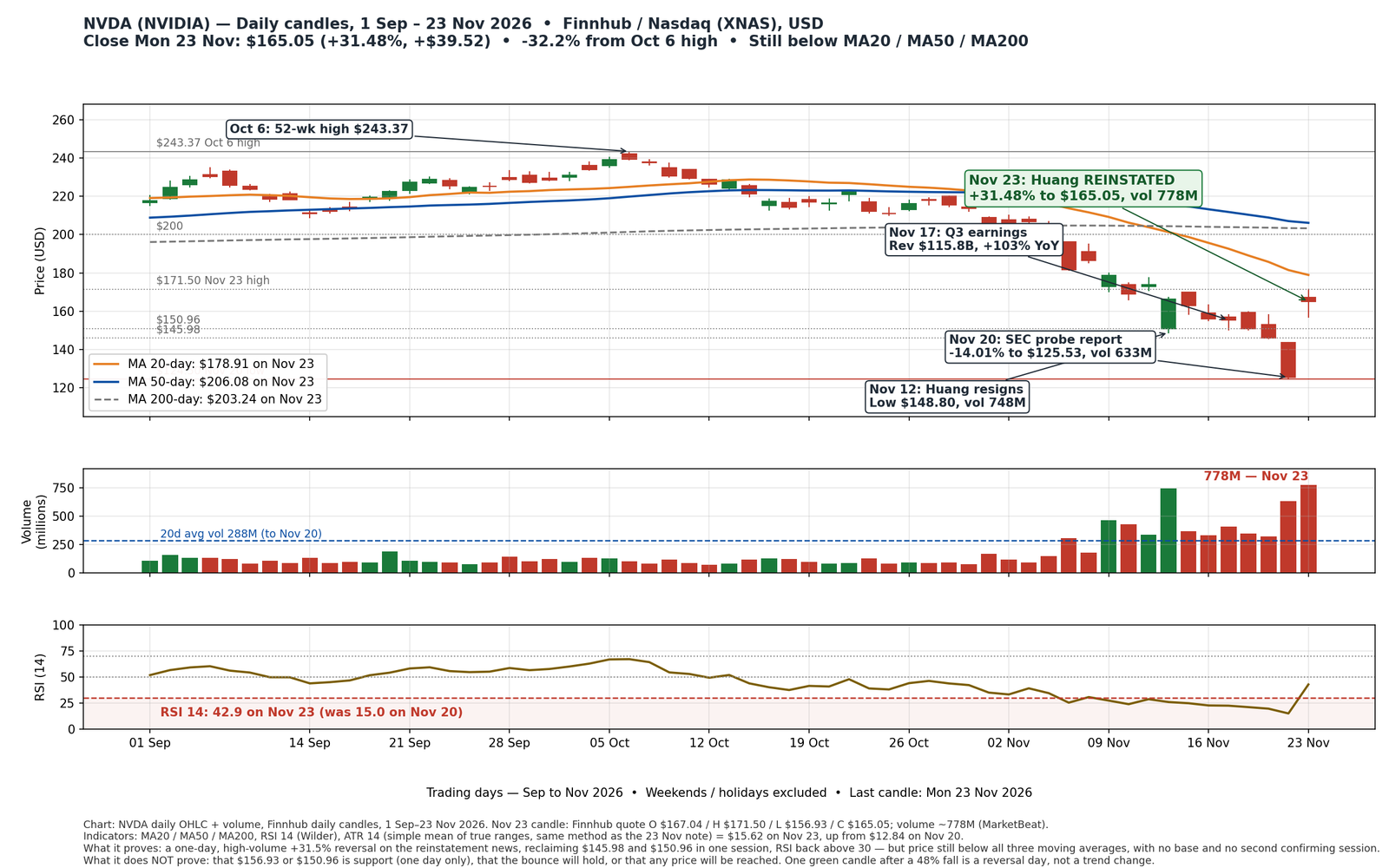
Chart caption: NVDA (NVIDIA Corporation, Nasdaq), daily candles, 1 September – 23 November 2026 (59 trading days), as of 24 November 2026. Last candle: Monday 23 November 2026, close $165.05. Price source: Finnhub daily candles, Nasdaq (XNAS), USD. Indicators: MA 20-day ($178.91), MA 50-day ($206.08), MA 200-day ($203.24), volume, RSI 14 (Wilder, 42.9); ATR 14 $15.62. Support/resistance marked: $243.37 (6 October high), $200, $171.50 (23 November high), $150.96 (18 November close), $145.98 (19 November close), $156.93 (23 November low). What the chart proves: a steep, high-volume downtrend since 6 October, then a one-day, high-volume reversal on 23 November on the reinstatement news, reclaiming $145.98 and $150.96 in a single session, with RSI back above 30 — but price still below all three moving averages, with no base and (as of 23 Nov) no second confirming session. What it does not prove: that $156.93 or $150.96 is support (one day only); that the bounce will hold; or that any price will be reached, or when. After-hours $166.79 on 23 November is not a regular-session close and is not on this chart.
The 52-week high was $243.37 intraday on 6 October 2026. Moving averages on 23 November, from Finnhub daily candles over the full 260-day series plus the 23 November quote candle: MA20 $178.91, MA50 $206.08, MA200 $203.24. Price was 7.7% below the MA20, 19.9% below the MA50, and 18.8% below the MA200. The MA50 is still just above the MA200 — no 50/200 death cross yet — but that is a lagging technicality. There were seven straight daily falls to 20 November, and seven straight weekly falls — the longest weekly losing streak since 2008 — and then one day, 23 November, that reversed a large part of the week’s fall in a single session. NVDA is now 5.5% below its 21-month EMA ($174.62), having been 28.1% below it on 20 November — a long-term trend fact, not a swing signal.
Overhead resistance is stacked: $171.50 (23 November high) is nearest, then the MA20 at $178.91, $200, the MA200 at $203.24, the MA50 at $206.08, and the $243.37 high. Below the price, $156.93 — the 23 November intraday low — is one print only, not tested support. $150.96 and $145.98 were reclaimed on 23 November, but a level reclaimed in a single session is not proven support until it is tested and held.
Volume on 23 November was about 778 million shares, against a 20-day average of 287.6 million — 2.7 times average. It was the stock’s best day since 2003 by percentage gain. RSI 14 was 42.9 on 23 November, back above 30 from 15.0 on 20 November. What RSI 42.9 proves is that the extreme selling of the previous 14 sessions has eased in a single day. What it does not prove is that a trend change has happened: one green candle after a 48% fall is a reversal day, not a trend change. ATR 14 was $15.62; ATR 20 was about $11.00 on 20 November. Volatility expanded on the reinstatement day — it did not contract. Beta is 2.42 (Finnhub): NVDA moves, on average, more than twice as much as the market.
Sentiment
Timeline. 11 Nov: the board accepted Jensen Huang’s resignation as President, CEO, and Board member, effective immediately — verified in NVIDIA’s Form 8-K, date of report 11 November 2026. 12 Nov: Colette M. Kress (CFO, age 59) was appointed interim CEO, while remaining CFO; Harvey C. Jones (age 73) was appointed first-ever Chair. Chair Jones said on the 17 November earnings call that the board did not intend to reinstate Huang — that was the board’s position at the time; Huang posted on X that he would be honoured to return if the board decided it was in the company’s best interest. 17 Nov: Q3 earnings were reported, and the stock fell anyway. The Wall Street Journal reported the same day that the SEC had opened a civil investigation into whether NVIDIA disclosures misled investors; the Journal could not establish the focus, and neither the SEC nor NVIDIA confirmed it on the record. 19 Nov: California Attorney General Rob Bonta served an investigative subpoena on NVIDIA. 20 Nov: Reuters reported that SEC enforcement staff are probing potential accounting issues, citing two people briefed on the matter; the SEC declined to comment, and NVIDIA did not immediately respond. The same day, the S&P 500 entered correction and the Nasdaq fell 5.3%. 22 Nov: the board voted unanimously to reinstate Huang as President, CEO and board director, effective immediately — reversing its 17 November position. 23 Nov: Nvidia announced the reinstatement before the market opened (NVIDIA Newsroom press release; Form 8-K filed 23 November, period of report 22 November). The stock closed at $165.05, up 31.48% on the day. The independent investigation continues — the reinstatement does not close it.
Verified vs reported. “Q3 revenue $115.8 billion, up 103%, guidance $130 billion” — verified, in the press release / SEC 8-K of 17 November 2026. “CEO Jensen Huang exit” — verified, in the Form 8-K of 11 November 2026 and the press release of 12 November 2026. “Huang reinstated as CEO” — verified, in the NVIDIA Newsroom press release and Form 8-K of 23 November 2026 (vote taken 22 November). “SEC accounting probe” — reported, not SEC-confirmed. No SEC order, filing, or finding has been published as of 23 November. A delayed 10-Q during an SEC probe is a fact to note, not a conclusion to draw.
Analyst consensus is still Buy, but it is a Buy with cuts: TipRanks (40 analysts): 26 Buy, 13 Hold, 1 Sell, average target $231.16–$232.33, low $130. On social media, AltIndex’s Reddit most-mentioned list for 22 November 2026 had NVDA at number one, with 1,644 mentions in 24 hours, sentiment Neutral. Tone was mixed; market mood overall was fear.
Why There Is No Trade
Verdict: no clean swing setup. Watchlist only. Do not enter on this article.
This is a specific, maths-based conclusion under our paper rules: $10,000 paper, $100 risk (1%), maximum position $2,500 (25%), stop mandatory, target 1.5–2R, hold two days to three weeks. ATR 14 on 23 November was $15.62 — up from $12.84 on 20 November, so volatility expanded on the reinstatement day.
Example A — ATR-based stop (the disciplined version). Hypothetical entry $165.05 (the 23 November close, for maths only). Stop: $165.05 − $15.62 (1× ATR) = $149.43. Risk per share: $15.62. Shares for $100 risk: $100 / $15.62 = 6 shares (6.4 rounded down). Position size: 6 × $165.05 = $990 (9.9% of the account). Target at 1.5R: $188.48. Target at 2R: $196.29. The problem: the targets need another 14–19% on top of a 31% day, through the 23 November high ($171.50) and the MA20 ($178.91), with no base and no second confirming session. And the stock opened $41.51 above Friday’s close on Monday — it can gap down the same way on the next headline, and a stop does not protect against an opening gap. Buying the day after a 31% spike is chasing a headline, not a swing setup.
Example B — Tight stop (the tempting version). Hypothetical entry $165.05. Stop $156.93 (below Monday’s intraday low, $8.12 risk per share). Shares for $100 risk: $100 / $8.12 = 12 shares. Position size: 12 × $165.05 = $1,981 (19.8% of the account). Target at 1.5R: $177.23. Target at 2R: $181.29. The problem: $8.12 is 0.52× ATR. A normal intraday swing would stop you out before the trade has a chance to work. You would be right about the direction and still lose. Monday’s low is also a single print, not tested support.
Conclusion: there is no stop distance that is both (a) wide enough to survive normal volatility and (b) tight enough to give a meaningful position and a clean 1.5–2R target through resistance, without gap risk.
What Would Have to Change
Revisit NVDA only if all of these are true — not just one. Three of them fired on 23 November, in a single day, which is exactly why they are not enough on their own:
- Price: a daily close above $145.98 (19 November close), then above $150.96 (18 November close) — fired on 23 November ($165.05) — and hold above $150.96 for two sessions on volume above 300 million shares — Update 24 Nov: met — the 24 Nov close was $155.38 on about 384M shares, above $150.96 for a second session.
- Structure: a higher low forms — a pullback that holds above the prior low, then a higher high. A base of three to five days, not a single green candle. Not yet — one day is not a base.
- Momentum: RSI 14 back above 30 and rising — fired (42.9 on 23 November) — and ATR contracting (daily ranges getting smaller, not larger) — not yet; ATR expanded to $15.62.
- News clarity: an update on the SEC probe — a filing, a statement, or a 10-Q — not yet; the probe is still reported, not confirmed, and the 10-Q is still delayed — and no new subpoena or charge. The CEO question is now settled: Huang was reinstated on 22 November, effective immediately, and Colette Kress has returned to CFO.
- Market: the S&P 500 stabilising — at least not making new correction lows that day. One day only: the S&P 500 rose 4.73% and the Nasdaq 6.51% on 23 November.
- Long-term EMA (added 23 November 2026, Toasty-approved): a reclaim of the 50-month EMA (approximately $130.89, provisional November) and a hold above it for a month. Price on 23 November was $165.05, above that level — the price part fired, but the hold-for-a-month condition has not (one day). This level alone does not create a swing setup; it is an additional long-term trigger, alongside the five above. It is not a stop, a target, or an entry.
If those triggers fire, a new research note should be written with a fresh chart, fresh entry, stop, and target, and fresh position sizing. Do not reuse the numbers in this article — they will be stale.
Risks
- Governance and leadership: the CEO question is now settled — Huang was reinstated on 22 November and Colette Kress has returned to CFO — but the independent investigation continues, and a new National Security and Export Control Committee has been formed. The reinstatement does not close the investigation.
- Regulatory and legal: SEC civil probe into accounting and disclosures (reported, not confirmed), California Attorney General subpoena, securities class action, export-control and China diversion investigations — any of these can produce a headline, a restatement, a fine, or a charge, or close with nothing, over months, not days.
- Accounting and disclosure: geographic revenue reporting change (Singapore), roughly $104 billion of 2025 revenue via the Singapore unit (Financial Times), receivables of $81.0 billion, DSO of 64 days — if the SEC finds disclosure was misleading, the consequences go to trust in the numbers themselves.
- Customer and capital-expenditure cycle: hyperscalers may cut capital expenditure (Bank of America survey: 52% of fund managers expect at least one hyperscaler cut within six months), and if they do, NVIDIA’s growth rate falls fast because its customers are concentrated.
- Competition: custom silicon (Google, Amazon, Microsoft, Meta), AMD as a second source, and potential China domestic alternatives.
- China and geopolitics: export controls, smuggling and diversion risk, US–China tensions.
- Balance-sheet commitments: $390 billion in supply commitments, $118 billion in guarantees, $39.7 billion in inventory — if demand slows, those are fixed obligations.
- Congressional calendar: a 1 December closed-door House interview, a 2 December Tim Teter appearance, and a 3 December Senate Banking hearing are all inside any two-to-three-week swing window (TipRanks, 17 Nov 2026, citing Politico; Reuters / SRN, 23 Nov 2026). A swing hold would carry headline risk from all three.
- Volatility and gap risk: ATR $15.62, beta 2.42, 20-day volatility 4.14%, −14% in one day on 20 November and +31.48% in one day on 23 November — a swing hold can lose more than the planned $100 risk on a gap, in either direction.
- Market risk: the S&P 500 is in correction, the Nasdaq is down for the year, and the AI trade is unwinding.
Verdict
NVDA on 23 November 2026 is a textbook case study in why price and fundamentals can diverge — and why a swing trader must respect both. As a business, NVIDIA just reported one of the strongest quarters any company has ever reported: $115.8 billion revenue, +103% year-on-year, $65.3 billion net income, $43.8 billion free cash flow. As a stock, it fell 48% in six weeks, then jumped 31% in a single day when its founder-CEO was reinstated — with an SEC probe reported, a California subpoena, a delayed 10-Q, and a market in correction still unresolved.
NVDA stays on the watchlist. It should be updated only on a material trigger: a base forming, ATR contracting, an SEC or 10-Q update, or a new base. (The second confirming session above $150.96 has now happened — 24 Nov close $155.38 on about 384M shares — so it is no longer on the list.)
Education only — not financial advice. Not a recommendation to buy, sell, or hold NVDA.
This article is for learning how to analyse a stock. It is not tailored advice for any reader. No trade was placed on the basis of this article, and no trade should be placed on the basis of this article alone. If the revisit triggers in the previous section fire, a new research note with a fresh chart, fresh entry, stop, and target, and fresh position sizing is needed first. Paper trading only. Show losses as prominently as wins. Follow CSA/CIRO Joint Staff Notice 31-369.
Sources and dates
All prices are USD unless stated. All “as of” dates are in the source.
Price / technicals
- Finnhub — NVDA, Nasdaq (XNAS), last regular close 23 Nov 2026 16:00 EST: $165.05, open $167.04, high $171.50, low $156.93, previous close $125.53, change +$39.52 (+31.48%), after-hours $166.79 (+1.05%). 52-week high $243.37 on 6 Oct 2026. TTM P/E 15.5493, beta 2.4217, average daily traded value $31.73B. Q3 FY27 actual EPS $2.68, revenue $115.844B. — https://finnhub.io/?q=%22NVDA%22 — accessed 24 Nov 2026. Daily candles in the Finnhub file (260 trading days to 20 Nov, plus the 23 Nov quote candle) were used to calculate MA20 $178.91, MA50 $206.08, MA200 $203.24, RSI 14 (Wilder) 42.9, ATR 14 $15.62, 20-day average volume 287.6M, all as of 23 Nov 2026. For the 20 November figures quoted in this article as history: close $125.53, after-hours $130.01 (+3.57%); 5 sessions −22.92%, 1 month −40.5%, 6 months −41.7%, YTD −32.69%, 1 year −29.82%; MA20 $181.46, MA50 $207.00, MA200 $203.35, RSI 14 15.0, ATR 14 $12.84, ATR 20 $11.00, volume 633.4M, all as of 20 Nov 2026.
- Kinzan — NVDA 20-day volatility 4.14% as of 23 Nov 2026. — https://kinzan.io/markets/stocks/nvda/
- EMA checks, 23 Nov 2026 — 21-month EMA $174.62 (price −28.1% below it on 20 Nov, −5.5% below it on 23 Nov); 50-month EMA ~$130.89, provisional November (price −4.1% below it on 20 Nov, above it on 23 Nov — hold-for-a-month condition not yet met), October complete-month EMA $131.11; 50-week EMA $195.65. Yahoo Finance daily closes, Nov 2016–Nov 2026, aggregated to weekly and monthly closes; EMA multiplier 2/(n+1), seeded from the SMA of the first n closes.
Earnings / filings (primary sources)
- NVIDIA press release / SEC 8-K, 17 Nov 2026 — “NVIDIA Announces Financial Results for Third Quarter Fiscal 2027”: revenue $115.8B +103% YoY, Data Center $107.6B +110%, Edge Computing $8.2B +42%, GAAP gross margin 74.8%, GAAP EPS $2.70, non-GAAP EPS $2.68, Q4 revenue expected $130.0B ±3%, dividend $0.25 payable 23 Dec 2026, record 2 Dec 2026. — https://www.sec.gov/Archives/edgar/data/1045810/000104581026000088/q3fy27pr.htm — https://nvidianews.nvidia.com/news/nvidia-announces-financial-results-for-third-quarter-fiscal-2027
- NVIDIA Q3 FY27 CFO Commentary / Supplemental Financial Information, quarter ended 25 Oct 2026 — GAAP operating income $77.5B, net income $65.3B, balance sheet: cash $29,089M, marketable debt securities $24,423M, marketable equity securities $44,219M, long-term debt $32,371M, total assets $372,188M, equity $266,666M, operating cash flow $48,253M. — https://investor.nvidia.com/files/doc_financials/2027/Q327/Supplemental-Financial-Information-NVDA-2027-Q3.pdf — https://www.sec.gov/Archives/edgar/data/1045810/000104581026000088/q3fy27cfocommentary.htm
- NVIDIA Newsroom, press release, 23 Nov 2026 — “NVIDIA Board Reinstates Jensen Huang as President, CEO and Board Director”: board voted unanimously (vote taken 22 Nov), effective immediately, satisfied with Huang’s candour and ability to lead, input from senior levels of the US government, confident no national security risk; independent committee investigation will proceed to conclusion; National Security and Export Control Committee formed; search for a Chief Compliance Officer. — https://nvidianews.nvidia.com/news/nvidia-board-reinstates-jensen-huang-as-president-ceo-and-board-director
- NVIDIA Form 8-K, filed 23 Nov 2026, period of report 22 Nov 2026 — reinstatement of Jen-Hsun Huang as President, CEO and Board member, effective immediately; Colette M. Kress returns to CFO; Harvey C. Jones remains Chair.
- NVIDIA Form 8-K, date of report 11 Nov 2026 — Board accepted resignation of Jen-Hsun Huang as President, CEO and Board member, effective immediately; Colette M. Kress appointed interim CEO; Harvey C. Jones appointed Chair. — https://d18rn0p25nwr6d.cloudfront.net/CIK-0001045810/2bc9480b-60a6-4d8a-90cb-87190f804a3b.pdf
- NVIDIA press release, 12 Nov 2026 — “NVIDIA Announces CEO Transition”. — https://nvidianews.nvidia.com/_gallery/download_pdf/6af5c3cc3d6332f541088655
- TipRanks, 17 Nov 2026, citing Politico; Reuters / SRN, 23 Nov 2026 — Congressional calendar: 1 Dec closed-door House interview, 2 Dec Tim Teter, 3 Dec Senate Banking hearing.
- Morningstar / Dow Jones, 23 Nov 2026 09:24 ET — reinstatement announced Monday morning; second source for the vote and announcement timing.
SEC probe / legal
- Reuters, 20 Nov 2026 — “Nvidia’s accounting is a focus of US SEC investigation, sources say” — SEC probing accounting practices, two people briefed on the matter, SEC declined to comment, Nvidia did not immediately respond, focus / start date not determined. — https://live.euronext.com/en/financial-news/nvidias-accounting-focus-us-sec-investigation-sources-say
- Motley Fool, 21 Nov 2026 — “After Its Worst Week in 18 Years, Nvidia Now Faces an SEC Investigation” — Reuters report, WSJ 17 Nov civil probe, investigation ≠ wrongdoing, many probes close without charges. — https://www.fool.com/investing/2026/11/21/after-its-worst-week-in-18-years-nvidia-now-faces-an-sec-investigation-what-it-means-for-investors/
- Dealroom, 20 Nov 2026 — SEC probe turns to accounting, shares fall 14%, seventh straight daily fall and seventh straight weekly drop. — https://dealroom.co/news/174723-sec-probe-of-nvidia-turns-to-its-accounting-as-shares-fall-14-and-close-/
- YourStory, 17–18 Nov 2026 — Chair Harvey Jones: board does not intend to reinstate Huang as CEO (position as of 17 Nov — reversed by the unanimous reinstatement vote of 22 Nov, see reinstatement sources above); Huang voluntarily resigned after disclosure of personal behaviour inconsistent with code of conduct; Heidrick & Struggles retained for CEO search; National Security and Export Control Oversight Committee established. — https://yourstory.com/2026/11/nvidia-chair-says-no-plan-to-reinstate-jensen-huang-as-ceo
Market / sentiment
- Motley Fool, 20 Nov 2026 — “The S&P 500 Just Entered Correction Territory” — S&P 500 fell 3.7% Friday to 6,910.39, down 8.6% for the week, in correction (10%+ from high). — https://www.fool.com/investing/2026/11/20/the-sp-500-just-entered-correction-territory-heres-what-it-means-for-investors-right-now/
- AltIndex, 22 Nov 2026 — Reddit most-mentioned: NVDA 1,644 mentions in 24h, Neutral, $125.53, AI Score 73. WallStreetBets: NVDA 981 mentions. — http://altindex.com/reddit-stocks
- TipRanks, accessed 23 Nov 2026 — NVDA Moderate Buy, 26 Buy / 13 Hold / 1 Sell (40 analysts, 3 months), average target $231.16–$232.33, high $345, low $130. Target cuts 13–18 Nov listed in the sentiment section. — https://www.tipranks.com/stocks/nvda/forecast
- MarketBeat, accessed 23 Nov 2026 — NVDA Moderate Buy, 46 Buy, 15 Hold, 0 Sell (61 analysts), average target $263.66, high $515, low $170, market cap ~$3.03T at $125.56. — https://www.marketbeat.com/stocks/NASDAQ/NVDA/forecast/
Customers / concentration
- Q3 FY27 CFO commentary / secondary summaries: Hyperscale $60.1B (+71% YoY), AI Clouds / Industrial & Enterprise $47.5B (+195% YoY); two direct customers 18% and 17% of accounts receivable at 25 Oct 2026; receivables $81.033B at 25 Oct 2026 vs $38.466B at 25 Jan 2026; future supply commitments $390B, guarantees $118B. — Sources above (SEC / NVIDIA CFO commentary), plus https://sec-api.io/insights/nvidia-nvda-q3-fy2027-earnings-revenue-115-8bn-data-center-107-6bn-q4-outlook-130-0bn-sec-filing-analysis
Chart
- Chart PNG:
nvda-chart-2026-11-23-update.pngin the same folder as this article. Daily candles 1 Sep–23 Nov 2026, Finnhub / Nasdaq, USD. MAs, RSI, ATR, and volume calculated from the Finnhub daily-candle series as described in the technicals section. No other price source was used for the chart. (The original chart,nvda-chart-2026-11-23.png, covered 1 Sep–20 Nov only and is superseded.)
2 thoughts on “NVDA: Record Revenue, a 31% Rebound, and Still No Clean Swing Setup”