

Investingnetwork.com — Stock Analyst | 23 November 2026 | Canada / United States — TSX:T in CAD (primary), NYSE:TU in USD
Education only — not financial advice. Not a recommendation to buy, sell, or hold TELUS. This article is for learning how to analyse a stock, not tailored advice, and not a trade idea.
Paper-trading disclosure: all trade maths uses our flagship paper rules only — $10,000 USD paper account, 1% risk per trade ($100), max four positions, max 25% per position ($2,500), mandatory stop, target 1.5–2R. No real money is involved. No trade was placed on TELUS. Our paper Trader remains at $10,000 cash, zero positions.Currency warning: every price is in Canadian dollars (C$) unless it says US$. TSX:T trades in CAD; NYSE:TU in USD. The paper account is in USD, so a TSX trade carries foreign-exchange risk on top of share-price risk (rate about 1.433 CAD per USD, 20 November closes).
Key Takeaway
- TELUS rose 30.6% in five sessions — entirely on takeover news, not on its business. It closed Friday 20 November 2026 at C$15.86 on the TSX (US$11.07 on the NYSE), up from C$12.14 on 13 November. Over a month it is up 33.7%, but still down 12.33% year-to-date and 15.23% over one year.
- The bid is real, but the headline price is not the price. Québecor’s unsolicited, non-binding proposal is worth C$19.45 a share on paper — C$6.35 cash plus 0.1700 Québecor Class B shares per TELUS share, about C$31.31 billion in total. Paid partly in Québecor shares, which fell about 21% in the week, the live value had fallen to about C$16.77 by 20 November. TELUS, at C$15.86, trades at about 95% of that live value. Upside to the deal as it stands today is only about 5.7%.
- The business underneath is in reset, not growth. Third-quarter revenue fell 0.9% to C$5.026 billion, adjusted earnings per share missed consensus, and TELUS reported a net loss of C$660 million after an C$800 million goodwill impairment on TELUS Health — its second large impairment in two quarters, after C$2.1 billion on TELUS Digital in Q2. The dividend was cut 55% in July 2026.
- The chart is a flat base, then two gaps — not a trend. Price sits 22.8% above its 20-day moving average and 28.9% above its 50-day average, with RSI at 76.9, overbought. The only genuinely tested level is the pre-bid base at C$12.14, 23.5% below the current price.
- Verdict: watchlist only. No clean swing setup, no trade. The position-sizing maths fits here — unlike NVDA and ORCL, where it failed — but a trade needs a tested level, a trend, and a holding period that is not a coin flip on a press release. TELUS has none of those on 23 November 2026.
The business
TELUS is one of Canada’s three national telecom carriers, alongside Bell (BCE) and Rogers, headquartered in Vancouver and formed in 1990 from the merger of the Alberta and British Columbia telephone companies. The core is TTech — mobile wireless (about 10.4 million subscribers), fixed internet over PureFibre, television, and security: a subscription business with steady monthly revenue, low churn, and high capital intensity.
The diversifications are the problem. TELUS Health (digital health records, virtual care, pharmacy, benefits) was the growth story of the past decade; it is now the source of the Q3 C$800 million impairment, and TELUS is trying to sell it. TELUS Digital (TELUS International, TSX/NYSE:TIXT) sells customer-experience outsourcing; its revenue fell 11% in Q3, to C$637 million, as AI agents displace the agent-based work it sells. TELUS spent a decade diversifying away from being “just a phone company”; in 2026 it is reversing course, selling the diversifications, cutting the dividend, and returning to core telecom plus AI infrastructure.
The moat is a regulated oligopoly position in core telecom, with no moat in the businesses TELUS spent the last decade buying into. Three carriers, spectrum licences costing billions, and a fibre network built over decades mean a new national competitor cannot simply appear — which is why the bid is a regulatory event.
Fundamentals
Q3 2026, reported 6 November 2026: total revenue C$5.026 billion, down 0.9% year-on-year; service revenue C$4.5 billion, down 1%; TTech C$3.3 billion, up 1%; TELUS Digital C$0.637 billion, down 11%; adjusted EBITDA C$1.8 billion, down 5% (about 2% after stripping out C$78 million of one-time gains in Q3 2025); reported EBITDA C$1.549 billion, down 12%; net loss C$660 million after the C$800 million Health impairment; adjusted EPS C$0.16, vs consensus C$0.17; operating cash flow C$1.5 billion, down 1%; free cash flow C$396 million, down 35%.
The loss is an accounting loss, not a cash loss — but it is not meaningless. It follows the C$2.1 billion TELUS Digital impairment in Q2 2026, which produced a net loss of C$1.8 billion that quarter. Two impairments totalling C$2.9 billion in two quarters is a strategy failing in public, not a one-off.
Guidance for 2026, reaffirmed 6 November as updated 31 July: service revenue flat to down 2%, adjusted EBITDA down 2–4%, capital expenditure about C$2.6 billion, and free cash flow about C$1.8 billion, down from about C$2.5 billion. Q4 earnings are estimated for about 11 February 2027 — well outside a 2–3 week swing window.
The core is stable: 84,000 mobile net adds, churn at a three-year low of 1.01%, ARPU flat at C$57.22. Net debt to adjusted EBITDA was 3.6x at 30 September 2026, against a target of 3.0x or lower by end-2028; net debt is about C$29.6 billion. The dividend was reset on 31 July 2026: cut 55%, from C$0.4175 to C$0.1875 quarterly (C$0.75 a year). The DRIP discount ended 1 October 2026, and the payout target is now 45–60% of trailing-12-month free cash flow, down from 60–75%.
The efficiency program is about C$900 million in annualised cash savings exiting 2028, about 80% from core telecom. Health and Agriculture are in active sale processes, with proceeds earmarked for debt reduction — but selling Health after an C$800 million impairment means selling at the impaired value.
On valuation, market capitalisation is about C$25.25 billion at the 20 November close, on 1.59 billion shares, and price-to-sales is about 1.25x. Price-to-earnings is not usable: trailing GAAP earnings are negative after C$2.9 billion of impairments. The 4.7% yield is the only clean anchor, and it is a yield on a dividend cut 55% four months ago.
The bid
Québecor’s proposal is unsolicited, non-binding, and conditional: C$6.35 cash plus 0.1700 Québecor Class B shares (QBR.B) per TELUS share, headline value C$19.45 per share, about a 60% premium to the 13 November close of C$12.14, equity value about C$31.31 billion. The first written proposal was made 26 June 2026, shortly before Victor Dodig succeeded Darren Entwistle as chief executive on 1 July. It was enhanced 9 November and made public 16 November.
The catch is the payment. Paid partly in Québecor shares, the bid’s value moves with Québecor’s share price — and QBR.B fell about 21% in the week: C$77.06 on 13 November, C$65.25 on 16 November (−15.3%), C$56.96 on 17 November, C$59.13 on 19 November, about C$61.30 on 20 November. Recomputing — C$6.35 plus 0.17 × the QBR.B close — the live value fell from C$19.45 on 13 November to about C$16.77 by 20 November. TELUS at C$15.86 trades at about 95% of that live value: the market is pricing in a deal that probably does not close at the headline price, if it closes at all.
Two corrections to the headlines. First, the big day was Thursday 19 November, not Friday 20 November: TELUS rose 13.72% on 19 November, to C$15.50, and 2.32% on 20 November, to C$15.86. Second, the “29%” headlines from 16 November are not supported by TSX data: on the TSX, the intraday high on 16 November was C$13.91, up 14.6% on the 13 November close, and it closed up 12.85% at C$13.70. The 29% figure appears in NYSE premarket and early-trading coverage, not in TSX official data.
TELUS’s board — through a special committee advised by TD Securities, with Stikeman Elliott as counsel — calls the consideration inadequate and flags significant regulatory and execution risk. Québecor has shown no committed financing, and four months after the first approach, the board has said Québecor “has yet to explain” how the deal could be approved under the current telecom framework.
There is also a possible counter-bid. The Globe and Mail reported on 19 November that BCE has held preliminary talks with TELUS and hired financial and legal advisers. That is a possible counter-bid, not a bid — and Québecor criticised the idea of a BCE deal on 20 November. A combined TELUS–Québecor would have 15.0 million mobile subscribers — Québecor owns Vidéotron, Freedom Mobile, and Fizz, with 4.6 million — ahead of Rogers’ 12.3 million and Bell’s 10.4 million, and would cut national carriers from four to three. That needs clearance from the Competition Bureau, the CRTC, and Innovation, Science and Economic Development Canada (spectrum licences). The Rogers–Shaw precedent shows this takes years and may require remedies that destroy the deal’s economics.
Technicals
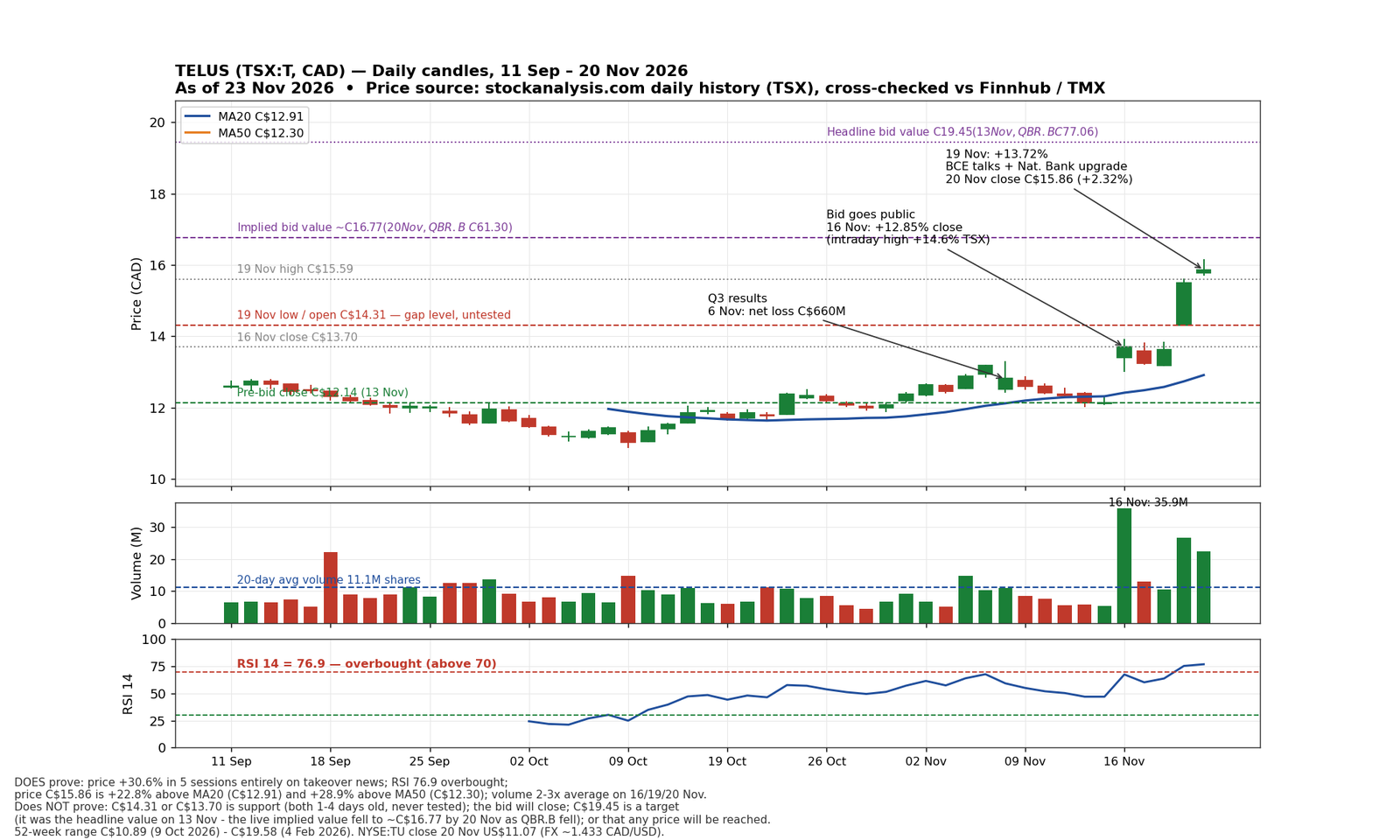
Chart: TELUS (TSX:T), daily candles, 11 September – 20 November 2026 (50 trading days), as of 23 November 2026. Price source: stockanalysis.com daily history (TSX), cross-checked against Finnhub and TMX. All prices in CAD. Indicators shown: MA20, MA50, volume, and RSI 14 (Wilder). Support and resistance levels and key events are marked on the chart. The window starts on 11 September because that is the first session in the fetched history table, so the MA50 is the average of the full 50-session window.
What the chart does prove: TELUS rose 30.6% in five sessions entirely on takeover news; RSI is 76.9 and overbought; price is 23–29% above its moving averages; volume was two to three times average on the gap days; and the pre-bid base was C$12.00–12.60. What it does not prove: that C$14.31 or C$13.70 is support; that the bid will close; that C$19.45 is a target; that the move continues; or that any particular price will be reached.
The trend before the bid was sideways-to-down for two months, then a vertical news gap. Price closed at C$15.86 on 20 November, against a MA20 of C$12.91 (price 22.8% above it) and a MA50 of C$12.30 (price 28.9% above it). Price above both averages is normally bullish. Here it is not a trend — it is a gap. Before 16 November, price spent the whole window below or around the moving averages, drifting from C$12.60 on 11 September to a 52-week low of C$10.89 on 9 October and back to C$12.14 on 13 November. The 52-week range is C$10.89 (9 October 2026) to C$19.58 (4 February 2026), and beta is 0.285 (Finnhub) — TELUS is normally one of the least volatile large caps in Canada, so a low-beta stock moving 30% in a week is, by definition, an event move, not a beta move.
The two gap days: on 16 November, TELUS opened at C$13.41 (gap up 10.5% from C$12.14), reached C$13.91, and closed at C$13.70, up 12.85%, on 35.9 million shares — 3.2 times the 20-day average of 11.1 million. The low was still 7.2% above the prior close: the gap never filled intraday. On 19 November, it opened at C$14.31 (gap up 5.0% from C$13.63), reached C$15.59, and closed at C$15.50, up 13.72%, on 26.6 million shares. On 20 November, it closed at C$15.86, up 2.32%, on 22.4 million — a quiet day after two gaps. On 17 November it fell 3.28% to C$13.25 — profit-taking after the bid.
The only genuinely tested level is C$12.14, the pre-bid close on 13 November and the top of the September–November base (C$12.00–12.60 for weeks) — but it is 23.5% below the current price, and useless as a swing stop: a stop there would risk C$3.72 a share. C$14.31 is not support: it was touched once, at the open on 19 November, in a gap-up, and never went back to it.
RSI 14 is 76.9 — overbought (above 70), up from about 47–48 through most of October and about 68 on 16 November. ATR 14 is C$0.56, but that is a quiet-October number: the last five sessions averaged a true range of C$1.12 — double the ATR.
The longer moving averages, checked on 23 November 2026: TELUS is 17.1% above its 21-week EMA (C$13.54) and 8.5% below its 21-month EMA (C$17.33), and 2.5% above its 50-week EMA (C$15.47) — but that level was not added as a revisit trigger, because price gapped over it on the bid and never tested it: on 13 November TELUS was 21.5% below its 50-week EMA, and by 20 November it had jumped over it in a week. The 50-week EMA is not support, and the 21-month EMA is not a target — it is a 21-month average, not a deal value; the live implied bid value is about C$16.77.
Sentiment
TSX consensus (S&P Global, via stockanalysis.com, 17 analysts) is Hold, with an average target of C$14.53, a range of C$11.50–C$19.00, and a median of C$14.50. The average target is 8.4% below the 20 November close.
The two most recent upgrades are both explicitly about the bid, not the business. National Bank’s Adam Shine upgraded TELUS on 19 November from Sector Perform to Outperform, target C$14.00 raised to C$16.00 — while also writing that he does not see how Ottawa can approve the deal. Barclays’ Kannan Venkateshwar upgraded on 20 November from Equal Weight to Overweight, target US$10 raised to US$13, citing potential deal activity and a possible BCE deal.
TELUS does not appear in the AltIndex top-10 most-mentioned lists that NVDA (1,644 mentions) and ORCL (144–148) led on 22 November. Canadian social discussion is negative on the deal, not on TELUS — sceptical about approval, worried about prices and a duopoly — and news tone (NexusTrade, as of 20 November) averaged −32 across 118 headlines over the last 30 sessions, vs a one-year average of +4.
The key split: the stock is up 30% on deal hope; the public conversation is against the deal happening. Both agree revenue is flat, earnings are impaired, debt is 3.6x, and the bid is non-binding and conditional. They disagree about whether a regulator will let a four-carrier market become three — a political question, not a chart question.
Why there is no trade
Verdict: no clean swing setup on 23 November 2026. No trade. Watchlist only.
This one is different from NVDA and ORCL. In those two notes, the position-sizing maths failed — no stop fitted the $100 rule. Here the maths fits. The trade still does not exist, because a swing setup needs more than arithmetic: a tested level, a trend, and a holding period that is not a coin flip on a press release. Here is the maths, shown honestly, and then why it is not enough.
All figures are in CAD unless marked US$. The exchange rate is about 1.433 CAD per USD (20 November closes). Entry C$15.86 is US$11.07. The $100 USD risk budget is C$143.27. Stop below the 19 November gap low (C$14.31): risk C$1.55 a share, or US$1.08 a share. Shares: $100 / US$1.08 = 92 shares. Position: 92 × US$11.07 = US$1,018 (10.2% of the account) — inside the 25% cap. Loss if stopped: US$99.36. It fits the $100 rule. Targets: 1.5R = C$18.18 (US$12.69); 2R = C$18.96 (US$13.23). A stop below the 16 November close (C$13.70) also fits — 66 shares, a US$731 position, a US$99.66 loss if stopped — with targets of C$19.10 and C$20.02. A stop below the tested pre-bid base (C$12.14) also fits on paper — 38 shares, a US$421 position — but its targets (C$21.44 and C$23.30) sit above the headline bid value, which shows how absurd that stop is as a swing level.
Six reasons the fitting maths is not a setup: (1) No tested support. C$14.31 was touched once, at the open on 19 November, in a gap-up, and never retested. C$13.70 is a single close. The last five sessions’ average true range is C$1.12 — 72% of the entire C$1.55 risk in the C$14.31 stop. (2) Gap risk in both directions. 19 November gapped 5.0% higher at the open; 16 November gapped 10.5% higher. A negative headline gaps down the same way, and a stop at C$14.31 does not protect against an open at C$13.50. (3) The holding period is a coin flip. The TELUS–Québecor management meeting is today, 23 November. (4) The targets are deal-arbitrage numbers, not chart levels. The 1.5R and 2R targets (C$18.18 and C$18.96) sit between the live implied bid value (about C$16.77) and the stale headline (C$19.45). (5) The price already contains the deal. At C$15.86, TELUS trades at about 95% of the live implied bid value. Upside to the deal as it stands is about 5.7%, while failure likely means a re-test of C$12.14 (−23.5%). (6) RSI 76.9, overbought, after a vertical move. Chasing an overbought, low-beta stock 30% above its pre-bid price, into a binary event, is the opposite of the discipline in our swing-trading articles.
There is no short setup either. A cash account cannot short, and shorting a stock with a live takeover bid and a possible BCE counter-bid is chasing, not trading — a higher bid can gap the stock up 10% overnight.
What would have to change
Do not trade on these triggers without a fresh research note. They are the conditions under which a new note would be written: (1) deal clarity — a definitive agreement, a BCE counter-bid with committed financing, a clear rejection by the TELUS board, or a substantive regulatory signal from the Competition Bureau, the CRTC, or the minister; (2) after the news resolves, a base — several sessions holding above a level (for example C$14.31) after the gap, with volume normalising toward the 11.1 million average, not two to three times it; (3) RSI 14 cooling below 70; (4) a higher low, or a sideways consolidation above the gap level, not a single green candle; and (5) fourth-quarter earnings on about 11 February 2027 — revenue, free cash flow, and any update on the transformation and divestitures, read from the release itself. If those fire, the Trader will get a fresh note with a real entry, stop, target, and sizing. Until then, no entry exists for TELUS that a swing trader can defend — and anyone quoting entry, stop, and target numbers for this stock today is quoting deal-arbitrage numbers, not a swing setup.
Risks
Risks of the company: deal collapse — if Québecor withdraws or the board rejects the bid, the stock likely gaps back toward C$12.14 (−23.5%), since the entire 30% move is deal premium; regulatory block — the Competition Bureau, CRTC, and ISED must all clear a four-to-three carrier deal, and the Rogers–Shaw precedent shows this takes years and may require remedies that destroy the deal’s economics; Québecor’s falling shares shrink the bid — every 10% fall in QBR.B cuts about C$1.05 off the implied value, and QBR.B is already down about 21% since 13 November; and leverage (3.6x) plus the transformation grind — if the bid fails, TELUS returns to a two-year deleveraging plan with flat revenue, a cut dividend, TELUS Digital revenue down 11%, and Health being sold after an C$800 million write-down, with more impairment possible if the sale price comes in lower.
Risks of trading this name now: gap risk — two 5–10% gaps in four sessions, in either direction, and a stop does not protect against a gap; binary-event risk — the 23 November meeting, a minister’s remark, or a BCE decision can move the stock 10% before the open; currency risk — a TSX trade in a USD account adds CAD/USD movement, and at 1.433 a 1% move in the loonie is about 1% on the position; narrative risk — “up 30% on a $31 billion bid” is a compelling story and a terrible reason to buy, because the bid is non-binding, conditional, unfinanced as disclosed, and already worth C$2.68 a share less than its headline.
Verdict
TELUS is a watchlist name, not a swing trade, on 23 November 2026. No trade is passed to the Trader.
What a learner should take from this article: (1) A takeover bid changes the question. Before 16 November, TELUS was a flat-revenue, leveraged telecom with a cut dividend trading at C$12.14. After 16 November, it is a deal. The business did not change in four days; the question did — from “what is this company worth?” to “what will someone pay for it, and will the regulator let them?” (2) The headline price is not the price. C$19.45 was the bid’s value on 13 November, when Québecor’s shares closed at C$77.06. By 20 November the live value was about C$16.77, because the bidder’s own shares fell 21%. (3) Maths that fits is not the same as a setup. NVDA and ORCL failed the $100 risk rule. TELUS passes it — and still fails, on tested support, trend, gap risk, and a binary event. The risk rule is one filter, not the only one. A trade needs all of them: size, level, trend, and a holding period that is not a coin flip. (4) Overbought after a gap is not momentum to chase. RSI 76.9 after +30.6% in five sessions is exhaustion, not strength — especially in a stock with a beta of 0.285 that normally moves about 1% a day. (5) Watch the regulator, not just the stock. The Competition Bureau, the CRTC, ISED, and the Industry Minister will decide TELUS’s next year. If the deal is blocked, the stock goes back to C$12–13 and the two-year transformation grind. If a bidding war starts, it goes higher. The stock price will follow the politics — it has for the last four days. (6) Three for three. NVDA, ORCL, TELUS — all three first-watchlist names, no clean setup in any of them, for three different reasons: a falling knife with an untradeable stop, a leveraged balance-sheet collapse, and a binary takeover spike. That is not bad luck. It is what a market in correction looks like: the names people are talking about are the names you should not be trading. Waiting is a position.
Next steps: track TELUS in the background. Revisit only on the triggers above, or on material news — the 23 November meeting outcome, any BCE bid, any regulatory statement, any Québecor financing disclosure, or fourth-quarter earnings on about 11 February 2027. The first watchlist queue (NVDA, ORCL, TELUS) is now complete — all three notes done, all three watchlist only, Trader still at $10,000 cash, zero positions.
Education only — not financial advice. Not a recommendation to buy, sell, or hold TELUS. This article is for learning how to analyse a stock.
Sources and dates
All prices, figures, and events are as of 23 November 2026 unless stated otherwise. Where sources conflict, the conflict is noted rather than hidden. All TELUS prices are TSX:T in CAD unless marked US$ (NYSE:TU).
Prices and technicals
- stockanalysis.com, TELUS (TSX:T) historical data (accessed 23 Nov 2026): full daily OHLC + volume table, 11 Sep–20 Nov 2026, used for the chart and for MA20 C$12.91 / MA50 C$12.30 / RSI 14 76.9 / ATR 14 C$0.56 / 20-day average volume 11.1M — all calculated by the Stock Analyst from those 50 candles. Key closes: 13 Nov C$12.14; 16 Nov C$13.70 (+12.85%, high C$13.91, vol 35.9M); 17 Nov C$13.25 (−3.28%); 18 Nov C$13.63 (+2.87%); 19 Nov C$15.50 (+13.72%, high C$15.59, low/open C$14.31, vol 26.6M); 20 Nov C$15.86 (+2.32%, high C$16.14, low C$15.72, vol 22.4M). NYSE:TU close 20 Nov US$11.07 (+2.69%), 19 Nov US$10.78 (+13.35%).
The bid
- Lexpert, “Québecor proposes $31B combination with TELUS; special committee reviewing”: unsolicited, non-binding proposal, ~C$31B equity, C$6.35 cash + 0.1700 QBR.B per share, ~C$19.45 per share, ~60% premium to C$12.14 close 13 Nov; ~1.6B fully diluted shares; net debt ~C$29.6B; EV ~C$60.6B; first approach late Jun 2026 (written proposal 26 Jun, received 27 Jun), enhanced proposal 9 Nov, response letter 15 Nov, public 16 Nov; Dodig invited Péladeau to meet 23 Nov with CFOs; Stikeman Elliott counsel, TD Securities financial advisor; no assurance a transaction will result. https://www.lexpert.ca/big-deals/quebecor-proposes-31b-combination-with-telus-special-committee-reviewing/394787
- Morningstar / Dow Jones, 16 Nov 2026: proposal C$31.31B (US$21.96B), C$19.45 a share. https://www.morningstar.com/news/dow-jones/2026111611763/quebecor-makes-2196-billion-bid-for-telus-in-canadian-telecom-deal-3rd-update
- MobileSyrup, 16 Nov 2026: ~C$160M operating synergies, ~C$235M annual capital efficiencies; TELUS board: regulatory review “long and costly”. https://mobilesyrup.com/2026/11/16/quebecor-telus-merger-31-billion/
- Toronto Journal, 17 Nov 2026: TELUS “rose as much as 29 per cent in early trading and closed Monday up 12.85 per cent at $13.70”; QBR.B fell 15.33% to $65.25.
BCE / analyst moves
- Globe and Mail (via stockanalysis.com news / TipRanks), 19 Nov 2026: BCE held preliminary talks with TELUS, hired financial and legal advisers.
- TipRanks / The Fly, 19 Nov 2026: National Bank upgraded TELUS to Outperform from Sector Perform, price target C$16.
- Barclays, 20 Nov 2026: upgraded TELUS to Overweight from Equal Weight, target US$10 raised to US$13.
- stockanalysis.com, TELUS analyst ratings (accessed 23 Nov 2026): TSX consensus Hold, average target C$14.53, range C$11.50–C$19.00, median C$14.50, 17 analysts.
Company results and guidance
- TELUS Q3 2026 press release, 6 Nov 2026 (PR Newswire / SEC 6-K Ex. 99.1): net loss C$660M (C$800M Health goodwill impairment), adj EBITDA C$1.8B −5% (normalised −2%), service revenue C$4.5B −1%, TTech C$3.3B +1%, TELUS Digital C$637M −11%, FCF C$396M −35%, operating cash flow C$1.5B −1%, net debt/EBITDA 3.6x, target ≤3.0x by end-2028, C$900M efficiency program, 2026 guidance reaffirmed (service revenue flat to −2%, adj EBITDA −2% to −4%, capex ~C$2.6B, FCF ~C$1.8B), dividend C$0.1875 payable 4 Jan 2027. http://www.prnewswire.com:443/news-releases/telus-reports-third-quarter-2026-results-demonstrates-continued-discipline-in-core-telecom-advances-transformation-strategy-814017677.html
- Nasdaq Q3 earnings-call transcript, 6 Nov 2026: mobile net adds 84,000, blended churn 1.01%, postpaid 0.87%, ARPU C$57.22 flat, internet net adds 10,000, AI infrastructure revenue C$500M projected over 3 years.
Sentiment
- NexusTrade TU news sentiment (as of 20 Nov 2026): average tone last 30 sessions −32 across 118 headlines, vs +4 one-year average; 20 Nov: 14 headlines, average −22. https://nexustrade.io/stock/TU/news-sentiment
- Toronto Culture Instagram carousel, 16 Nov 2026: C$35 (Apr 2022 peak) → C$12.42 (13 Nov 2026); dividend cut 55%; net debt 3.6x EBITDA; comments sceptical of approval / higher bills.